Your profit margin is about to feel pressure from four directions at once: cheaper rivals on the same shelf, rising ad costs as more sellers chase the same buyers, new duty and compliance costs in every market you enter, and shoppers who have more low-price options than ever. The trigger is a shift at the very top of the global e-commerce leaderboard.
Temu Has Held the #2 Spot in Global E-Commerce Traffic
Similarweb's global ranking of e-commerce & shopping websites puts Amazon first, with Temu in second, ahead of eBay, AliExpress, and Ozon. In the June 2026 snapshot, Temu ranked #2 — a position it has now held for three consecutive months in Similarweb's rolling monthly series. The list refreshes every month, so re-check the live page before citing the numbers.
Temu's traffic is also far more global than most sellers assume. Similarweb's temu.com traffic analytics show the United States contributing about 25.86% of Temu's desktop traffic, with Germany (5.95%), the UK (5.57%), Canada (4.50%), and France (4.15%) each bringing meaningful volume — and all remaining markets combined accounting for more than half of total visits. The buyer pool you are advertising to is no longer US-only.
The momentum is not limited to the desktop. According to Sensor Tower's state-of-e-commerce data, Temu ranks #2 in both website and mobile user scale among global e-commerce platforms, with mobile monthly active users up 24% year-over-year. The second-place position is being defended on both screens — exactly the channels where cross-border sellers advertise.
The Traffic Is Real — But Browsing Depth Still Lags
Scale and habit are not the same thing. In the same June 2026 snapshot, the engagement metrics tell the story:
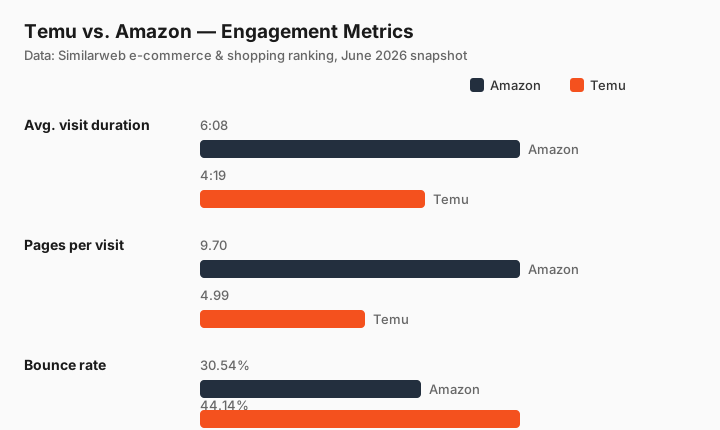
- Temu: average visit 4 min 19 s, 4.99 pages per visit, 44.14% bounce rate
- Amazon: average visit 6 min 08 s, 9.7 pages per visit, 30.54% bounce rate
These metrics do not directly equal conversion rates, but they describe a real gap in browsing depth — and for a seller they map to hard costs. Higher bounce rates and fewer pages per visit usually mean weaker on-site quality signals for ad platforms, and less surface area for cross-sell and upsell. Temu has solved the "getting people to the door" problem. The harder problem — the one that decides who profits — is getting shoppers to browse more, buy more, and come back on their own. For sellers, that makes retention and repeat purchase the battleground, not just first-click price.
Low Price Is No Longer a Unique Strategy
Temu's rise proves that low-price cross-border e-commerce can pull massive global traffic. It also means competitors are now building the same funnel on purpose.
Amazon launched Amazon Haul about two years after Temu entered the US market. The low-price storefront has since expanded to more than 25 countries and regions and carries over 1 million low-price products, most priced under $10. It is no longer an experiment — it is part of Amazon's global retail machinery, complete with Amazon's membership and after-sales moat.
On the AliExpress side, Choice is structurally closer to Temu's cross-border model: the platform integrates sales operations, payments, warehousing, and logistics, while merchants focus mainly on product development and production.
Strip away the differences and the pattern is clear: every major platform is now treating the price-sensitive consumer as a standalone business. That is good for volume and bad for anyone whose only competitive lever is price.
What This Means for You as a Temu Seller
1. Know your true margin — run the numbers before you price. Let's do a realistic example on a US listing. Say you sell at $15.00:
- Item cost: $4.00
- Sea freight: $1.20
- Platform + payment fees: $1.50
- US import duty (~8% of declared value): $1.20
- Landed cost: 7.10 (47%)
That 47% is your ceiling. Break-even ACoS ≈ 47% — the moment advertising consumes more than that share of a sale, you lose money. If you want a 12% net margin ($1.80), you have about \\35% of revenue left for ads\\; at a 4% conversion rate, that caps your cost per click around \\$0.21\\. Run your own numbers with the Temu Tariff & Landed Cost Calculator — duty, VAT, freight, and platform fees in one landed-cost figure — then set your ad ceiling with the Temu Break-even ACoS Calculator, which derives target ACoS and max CPC from your real margin.
2. Every new market adds cost lines you must price in. Europe already forms a large share of Temu's traffic — and it comes with EPR registration, GPSR label obligations, and VAT. These are not optional line items; they belong in landed cost before you set a price. Estimate registration weight with the Temu EPR Weight Calculator, generate compliant labels with the Temu GPSR Label Maker, then re-run the landed-cost math with them included.
3. Semi-managed vs. fully-managed changes who eats the logistics cost. Under fully-managed, Temu handles logistics; under semi-managed, you control freight and pricing but carry the cost yourself. The margin math is different, and the tool that shows the comparison is the Temu Semi vs. Full Managed Calculator. If you use semi-managed to enter a new market, your landed cost per unit is your single most important number.
4. Your ad efficiency is your moat. If everyone sells cheap, the listings that win are the ones whose owners can afford to keep advertising. When conversion dips or CPC spikes — and in a low-price war both will move against you — a seller who knows their break-even ACoS can react in minutes. Re-check yours with the Temu Break-even ACoS Calculator whenever you change price, COGS, or target conversion.
5. Run a weekly three-number check. Same day every week, look at: landed cost per unit (vs. last week), actual ACoS vs. break-even ACoS, and repeat-purchase share of orders. If any of the three stays in the red for two weeks in a row, act — renegotiate freight or supplier, cut CPC or bids, or change the bundle.
Run the Numbers Before You Race to the Bottom
Temu at global #2 changes the opportunity set for sellers, but it also removes the easy ride. The platforms are converging on low price; the sellers who win will be the ones who keep their unit economics honest while everyone else chases the cheapest click.
Start with the Temu Tariff & Landed Cost Calculator for your true landed cost, then the Temu Break-even ACoS Calculator for your ad ceiling — and when you need the rest of the kit (EPR, GPSR, deposit, POD, semi vs. full managed), the full Temu seller tools are one click away.
Data sources: Similarweb e-commerce & shopping website ranking (June 2026 snapshot), Similarweb temu.com traffic analytics, and Sensor Tower 2026 state-of-e-commerce data. Rankings and traffic figures update monthly — re-check the linked sources before citing them. Worked-example figures are illustrative; use your own costs and fees.