Every platform says the same thing to sellers: "low fees, fast growth." The reality is that the number on the rate card is only the beginning — payment processing, fulfillment, advertising, affiliate commissions, payout cycles, and return rates stack on top and quietly decide who actually makes money. If you are choosing between Temu, SHEIN, and TikTok Shop for the US or European market, here is what the official numbers actually say, side by side.
The Fee Landscape in 2026
All three platforms publish (or confirm in their seller centers) a base commission. The picture, as of 2026:
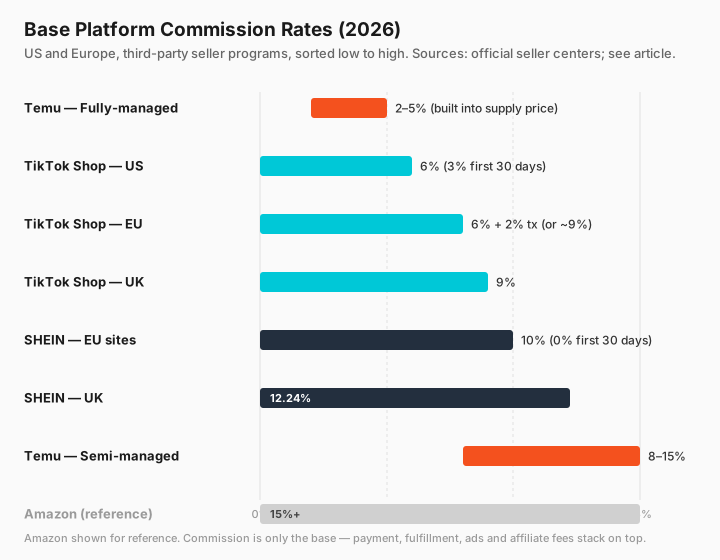
- Temu — fully-managed: commission of roughly 2–5%, built into the supply price you agree with the platform. Temu does not publish a public rate card; rates are confirmed in the Temu Seller Center during onboarding and vary by category.
- Temu — semi-managed: roughly 8–15% by category, plus payment processing (around 2.9% + $0.30 per transaction), and — in some markets — a \\$39/month subscription\\ for business accounts.
- SHEIN — Marketplace: per SHEIN's official Europe pricing page, 0% referral fee for the first 30 days, then 10% for EU sites and 12.24% for the UK, with €0 monthly subscription and €0 mandatory advertising. SHEIN's US seller portal advertises the same zero-monthly-fee structure.
- TikTok Shop: per the official seller site, a 6% commission in the US (5% on jewelry, and a 3% new-seller rate for the first 30 days), 9% in the UK, and in the EU around 6% plus a 2% transaction fee (some EU markets moved to a flat ~9% in early 2026, depending on the source). There is no setup fee and no monthly subscription, and new US sellers can earn up to $11,900 in launch incentives.
Amazon's 15%-plus referral fee is included on the chart purely as a reference point.
Temu: Two Models, Two Very Different Economics
Temu is the only platform here where "what you pay" depends entirely on which model you choose.
Fully-managed is the cheapest on paper — 2–5%, no logistics, no ads required — because the platform takes control of pricing, selection, and fulfillment. The trade-off is absolute: you lose pricing control and most customer contact. It suits manufacturers and wholesalers who care about volume, not brand.
Semi-managed costs far more — 8–15% commission, your own fulfillment and warehouse, payment fees, and in some markets the $39/month subscription — but you keep pricing power and can run local-warehouse delivery. Because Temu's fee schedule is confirmed per-category at onboarding rather than published, the honest advice is: do not budget from a blog post; check the seller center for your exact category before pricing anything.
SHEIN: The Simplest Fee Card on the Market
SHEIN's Marketplace is the easiest of the three to model, because the official page is explicit: zero monthly fee, zero mandatory advertising, 0% commission for the first 30 days, then 10% (EU) / 12.24% (UK), with weekly payouts. SHEIN monetizes through its own brand-first retail business; the marketplace program is designed to attract brands, with free promotional placements rather than paid ads.
The practical catch for sellers: SHEIN is fashion- and lifestyle-led. Commission is flat and simple, but the audience expects trendy, well-photographed, competitively priced products — which means your real cost is product photography, inventory turns, and return handling, not platform fees.
TikTok Shop: Low Base, Biggest Variable
TikTok Shop has the lowest base commission of the three for the US (6%) — but it is also the platform where the all-in number swings the most. Two costs push it up:
- Affiliate (creator) commissions. The majority of TikTok Shop volume comes through creators, and you set their commission — typically 10–20% of the sale. This stacks on top of the 6–9% platform fee. A $50 product with a 15% affiliate rate costs you \\$7.50 to the creator plus $3.00 to the platform — 21% of the sale before COGS and shipping\\.
- Fulfilled by TikTok (FBT). Optional, like FBA — from around $3.58 per unit for single-item orders, plus storage fees after a grace period.
Organic TikTok Shop sales (your own content, no affiliates) sit at 6–8% all-in — genuinely cheap. Affiliate-led sales — how most sellers actually grow — land more like 16–26%+. TikTok also tends to see higher return rates than search-based marketplaces, because purchases are impulse-driven; budget a return buffer.
The Real Cost: It's Not Just the Commission
Put it all together and the picture changes from the rate card:
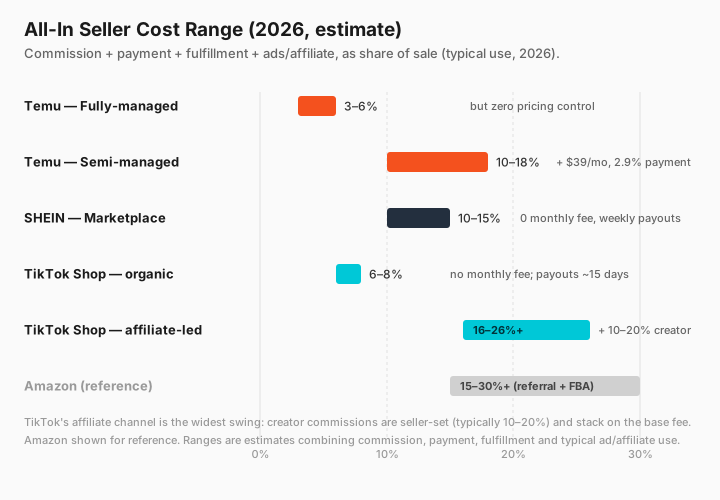
- Temu fully-managed: ~3–6% all-in — the cheapest, and the least control.
- Temu semi-managed: ~10–18%, plus subscription and payment fees where they apply.
- SHEIN: ~10–15% — flat and predictable, no subscription, no mandatory ads.
- TikTok organic: ~6–8% — the cheapest self-driven option.
- TikTok affiliate-led: ~16–26%+ — the most expensive way to scale on TikTok, and the most common.
Beyond the percentages, three non-commission factors decide your cash flow:
1. Payout cycles. SHEIN pays weekly; TikTok pays roughly every 15 days after order confirmation; Temu's cycles run longer (roughly 30–45 days fully-managed, longer for semi-managed). For a new seller, a 45-day payout is a real working-capital cost.
2. Returns. TikTok's impulse-buy return rates run higher; Temu's price-sensitive shoppers are also return-prone. Returns are a cost line on every platform, not an exception.
3. Compliance overhead. Selling into the EU adds EPR, GPSR labels, and VAT on all three platforms — the same compliance stack regardless of which marketplace you choose. VAT is the one that quietly changes unit economics: it is reclaimable for registered businesses but still hits your cash flow and your landed-cost math, so model it before you price, not after.
4. Hidden fee lines that don't show on the rate card. Three worth naming: TikTok charges a refund administration fee — roughly 20% of the referral fee, capped around $5 per SKU — on top of its higher impulse-buy return rates; Temu charges cross-border withdrawal fees (around 0.3–0.5%) on semi-managed payouts; and every platform here can levy late-fulfillment penalties if you miss SLA windows. None of these are in the commission charts, and all of them land on sellers who scale before their operations can keep up.
The Same $20 Product, Run Through Each Platform
Percentages only become decisions when they hit a real product. Here is the same listing — a 6 landed cost, no ad spend, mid-range commissions — run through each channel:
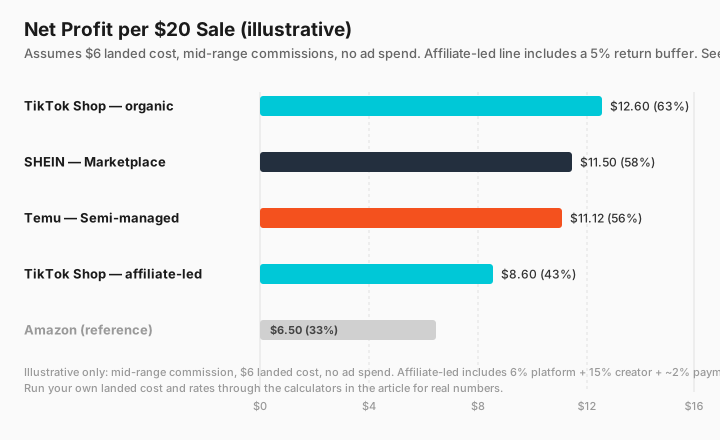
- TikTok organic: 6% platform + ~1% payment → $12.60 net (63%) — the best number, and it assumes you can drive your own traffic.
- SHEIN: 10% + ~2.5% payment → $11.50 net (58%) — flat and predictable, no ad obligation.
- Temu semi-managed: 10% + 2.9% + $0.30 payment → \\$11.12 net (56%)\\ — before any warehouse or ad cost.
- TikTok affiliate-led: 6% platform + 15% creator + ~1% payment, then a 5% return buffer → \\$8.60 net (43%)\\ — the swing from organic is roughly $4 per sale.
- Amazon (reference): 15% + FBA ≈ $4.50 → \\$6.50 net (33%)\\.
The same product, the same cost, and the gap between the best and worst channel is $6.10 per sale — 30% of the price. That is the difference between a product that scales and a product that just moves units. Run your own landed cost and your actual category rates through the calculators below; the ranking will change, but the method is the point.
Which Platform for Which Seller?
- Temu fully-managed → you are a manufacturer or wholesaler with thin margins who wants volume and zero operations. The low fee is real; the pricing control you give up is the price of it. Strongest categories: home & kitchen, general merchandise, budget consumables.
- Temu semi-managed → you have a local warehouse (US or Europe) and want pricing control. Model the 8–15% commission plus your fulfillment before committing. Best for sellers who already run local stock and can absorb longer payout cycles.
- SHEIN → you sell fashion, beauty, or lifestyle products and want a simple, brand-friendly marketplace with no fee surprises and weekly payouts. Best fit for brand-registered sellers; the audience skews female and fashion-first, so lifestyle and apparel convert far better than 3C or tools.
- TikTok Shop → you can create content or work with creators. Beauty, fashion, and demo-able novelty products win; products that photograph well but can't be shown working rarely justify the affiliate economics. Organic-first sellers get a genuinely low fee; affiliate-led scaling is expensive but can be the highest-ROI channel if your videos convert.
Market matters as much as category. Europe is already Temu's largest region by GMV — the platform shifted hard toward EU after the 2025 US tariff shock — so European sellers face a more mature, more competitive Temu than US sellers do. SHEIN's EU base is deep in fashion and lifestyle with strong local warehouse coverage. TikTok Shop is newer and less saturated in the EU than in the US, which means lower competition but also thinner traffic for most categories in early 2026. A US seller and an EU seller should not reach the same conclusion from this comparison.
Run the Numbers Before You Commit
Fee cards are percentages; profit is absolute. The same $15 product can be a winner on one platform and a loser on another once commission, payment, fulfillment, ads, and returns are priced in.
The math starts with landed cost: use the Temu Tariff & Landed Cost Calculator (it works for any platform — duty, freight, and fees into one landed-cost figure), then subtract each platform's real commission to see the per-unit margin. If advertising or TikTok affiliates are part of your plan, know your ceiling first with the Temu Break-even ACoS Calculator — the same break-even logic applies to creator commissions. And if you are weighing Temu's two models, the Temu Semi vs. Full Managed Calculator shows the profit crossover point. The rest of the kit is in the Temu seller toolkit.
Three actions you can take today:
1. Model one real product on all three platforms. Take your actual landed cost and run it through the tariff calculator, then apply each platform's commission + payment + return assumptions the way the $20 example above does. The ranking is your shortlist.
2. Set your ad or affiliate ceiling before you launch. Whatever channel you pick, the break-even ACoS number tells you the maximum cost per sale (or per creator commission) you can survive. Decide it now, not after the first invoice.
3. Decide Temu's model deliberately. If Temu is on your shortlist, run the same product through the fully-managed vs. semi-managed comparison — the crossover point is where your pricing control is worth the fees.
Data sources: Temu Seller Center (rates confirmed per category at onboarding; Temu does not publish a public fee schedule); SHEIN Marketplace official Europe pricing page (0% first 30 days, 10% EU, 12.24% UK, €0 monthly, weekly payouts) and US seller portal; TikTok Shop official seller site (6% US / 9% UK, no setup or monthly fee, new-seller incentives) and third-party fee trackers (Tiklytics, FeePilot, eBrands) for EU transaction fees, FBT pricing, refund administration fees, and affiliate ranges. Net-profit example is illustrative: mid-range commissions, $6 landed cost, no ad spend, 5% return buffer on the affiliate-led line — run your own numbers. All-in ranges and net figures are estimates, not guarantees — verify current rates in e