Most Etsy sellers outside the EU treat European orders as just another shipment. The parcel leaves the warehouse, the buyer pays, and the sale is done. For EU-bound orders that view is incomplete, and the gap is where listings get removed and shops get suspended. Two separate EU regimes touch every order to a European buyer: GPSR, the product-safety law that took effect December 13, 2024, and VAT, the import tax Etsy now collects at checkout on your behalf. This article separates the two, explains what each one actually requires of a non-EU seller, and gives the checklist that keeps your EU listings live.
The Two Regimes Sellers Confuse
They are different laws with different failure modes, and mixing them up leads to the wrong fix.
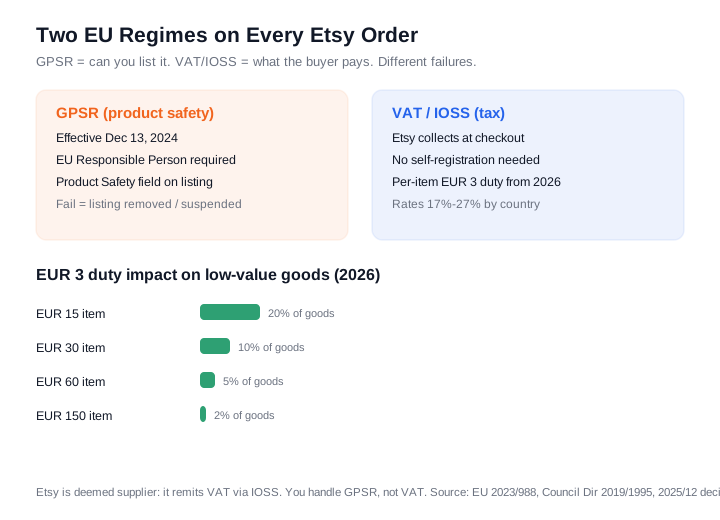
- GPSR (General Product Safety Regulation, Regulation (EU) 2023/988). Product safety. It decides whether your physical listing is allowed on the EU market at all. Fail it and Etsy removes the listing or suspends your EU sales.
- VAT / IOSS. Tax. It decides what the buyer pays at checkout and who remits it. On Etsy, the platform handles most of this for you, but the 2026 changes still change your landed cost.
A seller who loses a listing to GPSR does not fix it by adjusting tax settings. Knowing which regime you are dealing with is step one.
GPSR: What Changed and Why It Targets You (who needs an EU Responsible Person on Etsy)
GPSR replaced the old General Product Safety Directive and became enforceable on December 13, 2024 (see Etsy's official GPSR article). It applies to all non-food consumer products sold into the EU, the EEA, and Northern Ireland, including goods a US, UK, Canadian, or Chinese seller ships from outside Europe. Etsy flags sellers it classifies as "traders" (business accounts with a registered business or government ID) who ship to those regions, and requires compliance information on the listing.
For a Chinese seller specifically, this almost always applies: if you opened your shop with a business license or submitted a government ID, Etsy classifies you as a "trader," and shipping to the EEA or Northern Ireland triggers GPSR. The hobby-seller carve-out rarely covers an active shop. Assume GPSR is on you unless Etsy explicitly shows your account as non-trader.
The requirements that actually touch a small seller:
1. Manufacturer information. Name, email, and postal address on the listing. If you make the item, that is you.
2. An EU Responsible Person (RP). If you are established outside the EU, you must appoint an EU-based contact who holds your technical files and talks to authorities. Their details go on the listing and, where feasible, the product or packaging. No RP, no legal sale into the EU.
3. Product safety information. Age restrictions, choking or material warnings, usage instructions, and any applicable conformity markings, shown before purchase.
4. Technical documentation. Risk assessment, specs, test reports. Keep it for 10 years.
Etsy built a "Product Safety" section into the listing editor (Shop Manager -> Listing Manager -> Edit -> Product Safety) where you enter manufacturer and RP details. If you do not have your own EU entity, third-party compliance services act as your RP for roughly $200 to $600 per year; Etsy also points sellers to approved partner providers in the Product Safety section.
The stakes are specific: missing or incomplete GPSR information can get individual listings removed from EU search, your shop suspended from EU sales, or, for repeat violations, the account suspended entirely. Pre-December-13-2024 listings were grandfathered unless renewed, so an old listing you refresh loses that protection.
Do Digital Downloads Need a Responsible Person Under GPSR?
Mostly no, and this is the boundary many sellers get wrong. GPSR targets physical consumer products: the Responsible Person requirement, the product-safety pre-purchase info, and the technical-file obligation apply to goods that physically reach the EU. Pure digital downloads, such as an SVG template or a printable file delivered by email, fall outside the physical-product safety scope under the regulation's text, so they do not need an EU Responsible Person in the same way. The catch is twofold. First, mixed listings: if a digital file ships with a physical item, or you later add a physical variant, the physical part pulls the listing back under GPSR. Second, Etsy's own platform guidance states that GPSR applies to both physical and digital products on Etsy, so digital-only sellers should still check Etsy's current digital-listing requirements rather than assuming they are fully exempt. Treat digital-only as out of the regulation's physical scope, but confirm against Etsy's platform rules before skipping an RP.
VAT and IOSS: The Part Etsy Handles for You
This is the regime where non-EU sellers get needlessly alarmed. The short version: if you sell through Etsy, you mostly do not register for VAT yourself.
Under EU deemed-supplier rules (Council Directive (EU) 2019/1995), marketplaces like Etsy are liable for VAT on goods a non-EU seller ships to EU consumers, including items at or below €150 (EU import VAT guidance). Etsy collects the VAT at checkout based on the buyer's country rate and remits it through its own IOSS number. Your parcels clear customs under Etsy's IOSS, and you do not need your own registration. Sellers on their own storefront (Shopify, WooCommerce) are the ones who need to register separately.
Two facts worth locking in:
- The old €22 VAT exemption is gone. Since July 1, 2021, every parcel into the EU owes import VAT regardless of value. There is no small-order escape.
- Non-EU sellers get no threshold. EU-established sellers have a €10,000 intra-EU distance-sales threshold before destination VAT applies; sellers outside the EU charge destination VAT from the first sale. On Etsy this is invisible to you because Etsy collects it, but it sets the buyer's price.
One consequence sellers miss: because the buyer sees VAT plus the €3 duty baked into the displayed price, EU orders convert at a lower rate than domestic ones at the same item price. That lower conversion feeds straight back into the organic ranking signals (a listing that converts less ranks less) and into any ad-ROI math you run, so price EU goods with the conversion drag in mind rather than treating the payout as the only number that moved.
The 2026 Change That Raised Landed Cost
A change effective July 1, 2026 (EU Council Decision of December 12, 2025, official press release) already adds a flat €3 customs duty per item on IOSS-registered e-commerce imports at or below €150. IOSS still covers the VAT; this is a separate per-item duty on top. For a low-value order, €3 is a meaningful slice: on a €15 item it is 20% of the goods value before VAT. The buyer now sees VAT plus a €3 line at checkout, so show total landed cost and price accordingly.
VAT rates themselves vary by destination country and are the buyer's rate, not yours: Germany 19%, France, Spain, and Italy 20%, the Netherlands 21%, Ireland and Poland 23%, Sweden and Denmark 25%, Hungary 27% (highest), Luxembourg 17% (lowest) (European Commission VAT rates). Etsy applies the correct rate by shipping address; you do not set it.
What a Non-EU Seller Actually Does
Pulling it together, here is the real to-do list for a seller shipping from outside the EU to European buyers:
1. Decide if GPSR applies to you. If you are a business "trader" account shipping to the EEA or Northern Ireland, it does. Hobby sellers under the de minimis and pure digital-goods sellers may be outside it, but most active shops are in.
2. Appoint an EU Responsible Person. Either a third-party compliance service or your own EU representative. Budget $200 to $600 per year if you use a service.
3. Fill the Product Safety section on every EU-bound listing. Manufacturer name, email, address; RP details; applicable warnings. Do this before you refresh old listings, or you lose the grandfathering.
4. Do nothing for VAT on Etsy. Let the platform collect and remit. Your only action is pricing for the €3 per-item duty if you sell low-value goods from July 2026 on.
5. Keep your technical file for 10 years. Risk assessment, specs, test reports, in case an authority asks.
The common mistake is reverse: sellers panic about VAT registrations they do not need, while skipping the GPSR RP appointment that actually gets listings taken down.
The Calculator: Price for the New Landed Cost
The €3 per-item duty and the VAT Etsy collects change what an EU order nets you only at the buyer's price, not your payout, but they change whether the order is worth taking. The Etsy Fee Calculator shows what a sale pays out after Etsy's fees, so you can model whether a thin-margin EU order still works once the buyer's side carries VAT plus duty. For broader channel planning, the Etsy vs Shopify Calculator compares all-in cost per sale across platforms, including the VAT-handling difference between a marketplace that collects for you and a storefront where you register yourself.
Three Things You Can Do Today
1. Open one EU-bound listing and check the Product Safety section. Shop Manager -> Listing Manager -> Edit -> Product Safety. If manufacturer and RP fields are empty and you ship to Europe as a business, that listing is exposed.
2. Appoint your Responsible Person. If you have no EU entity, compare third-party compliance services against an independent RP and pick one. The $200 to $600 per year is cheaper than a removed listing.
3. Reprice low-value EU goods for the €3 duty. Any item at or below €150 you ship to the EU from July 2026 carries a flat €3 per-item duty on the buyer's side. Make sure your margins survive it before you keep advertising those listings to Europe.
A quick gut check. Ask: do I ship to the EEA or Northern Ireland as a business account, and does my Product Safety section name an EU Responsible Person? If the answer to the first is yes and the second is no, your EU listings are one compliance sweep from disappearing.
FAQ
Do I need to register for VAT myself to sell EU orders on Etsy? Generally no. Etsy is the deemed supplier and collects and remits VAT on your EU sales through its own IOSS number, including items at or below €150. You need your own VAT registration only if you sell through your own storefront, not through Etsy.
What happens if I ignore GPSR? Etsy can remove non-compliant listings from EU search, suspend your shop from EU sales, or suspend the account for repeat violations. The December 13, 2024 effective date means pre-existing listings are only grandfathered until you renew them.
How much does an EU Responsible Person cost? Etsy's partner services and independent representatives typically charge $200 to $600 per year. You need one if you are established outside the EU and sell physical consumer goods into the EU.
Does the €3 duty apply to all my EU orders? The flat €3 per-item customs duty applies from July 1, 2026 to IOSS-registered e-commerce imports at or below €150. Above €150, standard import procedures and duty by product apply instead. Etsy handles the VAT either way; this duty is separate.
Is VAT still charged on very small orders? Yes. The old €22 VAT exemption ended July 1, 2021. Every parcel into the EU owes import VAT at the destination country's rate, with no value exception.
GPSR (Regulation (EU) 2023/988) effective December 13, 2024, per Etsy's GPSR help article and seller-platform analyses (easecert, sellsafe, gpsrsolutions, insightagent), cross-checked August 2026. Requirements: manufacturer details, EU Responsible Person for non-EU sellers, product safety info pre-purchase, technical documentation retained 10 years; Etsy "Product Safety" listing field and third-party compliance services acting as RP (~$200-600/year). VAT/IOSS: EU deemed-supplier rules (Council Directive (EU) 2019/1995) make Etsy liable for VAT on non-EU seller goods to EU consumers including ≤€150; €22 exemption abolished July 1, 2021 (EU guidance); no threshold for non-EU sellers; flat €3 per-item duty on IOSS imports ≤€150 effective July 1, 2026 (EU Council press release, December 12, 2025). VAT rates by destination country (Germany 19%, France/Spain/Italy 20%, NL 21%, IE/PL 23%, SE/DK 25%, HU 27%, LU 17%) per the European Commission VAT rates page, 2026. Verify current requirements with Etsy and EU authorities, as both GPSR enforcement and VAT rules change.