Most Etsy sellers run ads without ever answering one question: did that ad order actually make money after the ad fee? Etsy makes it easy to turn ads on and hard to see what they cost. In its Q2 2026 results, Etsy reported services revenue of $212.2 million, up 11.2% year over year on the Etsy marketplace, while marketplace GMS rose only 7.5%. Advertising was the primary driver. That gap is the whole story of this article: ad revenue is growing faster than the sales it is supposed to support, which means a larger slice of every order is leaving through the ad line. This article shows how to tell whether your ad spend is paying for itself, and what to do when it is not.
The Headline Sellers Miss
Etsy breaks revenue into two buckets. Marketplace revenue is the transaction and payment fees. Services revenue is advertising, subscriptions, and similar. In Q2 2026, services revenue on the Etsy marketplace was $212.2 million, up 11.2% year over year, while marketplace GMS was $2.6 billion, up 7.5%. Advertising led the increase, helped by machine learning that improved ad relevance and seller budget pacing.
The take rate for the quarter was 25.9%, up 130 basis points year over year. Most of that move was a one-time ~130 bps from the Reverb divestiture; the roughly 50 bps of structural increase was ad-driven. When the company's own ad revenue grows faster than the sales volume, the structural points of take rate are coming from sellers paying more for ads, not from Etsy raising the visible transaction fee.
A nuance worth keeping straight: Etsy Ads and Offsite Ads are opt-in (Offsite becomes mandatory above $10K, discussed below). The growth is not a hidden fee. It is sellers spending more on ads that Etsy serves by default. The question is whether that spend comes back.
The Official Numbers Behind Ad Growth
| Metric | Q2 2026 value | Source | |
|---|---|---|---|
| Services revenue (Etsy marketplace) | $212.2M (+11.2% YoY) | Etsy Q2 2026 Shareholder Letter | |
| Marketplace GMS | $2.6B (+7.5% YoY) | Etsy Q2 2026 Shareholder Letter | |
| Marketplace take rate | 25.9% (+130 bps YoY) | Etsy Q2 2026 Earnings Call | |
| Of which, one-time (Reverb divestiture) | ~130 bps (one-time) | Etsy Q2 2026 Earnings Call | |
| Structural increase (Ads-led) | remainder of the 130 bps | Management commentary, Q2 call | |
| Adj. EBITDA margin | 29.2% (+210 bps) | Etsy Q2 2026 results |
The line that matters: services revenue grew 11.2% while GMS grew 7.5%. Advertising is the largest part of services, and management named it the primary driver of take-rate expansion two quarters running. That is the signal that ad load on sellers is rising.
Why You Cannot Tell If Ads Work
If ads are losing you money, why do so many sellers keep them on? Three reasons specific to Etsy:
1. The fee is invisible at the item level. Etsy Ads is on by default for most shops. You see a sale, not a line that says "this order cost you 12% to acquire."
2. Offsite Ads hides inside a 30-day window. If a buyer clicks an off-platform ad and returns to buy anything from your shop within 30 days, the order is attributed and charged, even if they came back through organic search. You pay for a sale you might have gotten anyway.
3. There is no clean per-order ROI view. Etsy shows ad spend totals, not "this specific order netted X after the ad fee." Sellers guess, and guessing defaults to keeping ads on.
The result: ad spend feels like a cost of doing business rather than a line item you can audit. That is exactly the habit Etsy's ad growth depends on.
Etsy Ads vs Offsite Ads: Two Different Fees
They are easy to confuse, and they stack differently.
- Etsy Ads. Promoted Listings inside Etsy search. You set a daily budget (or leave it uncapped) and a max cost per click. You pay per click (CPC), not a percentage of the order. It is optional at every level, and you control the budget. Whether those clicks turn into sales is on you. A concrete feel for the math: on a $30 order, if the clicks that led to that sale cost you $1.20 total, that is your real acquisition cost for that order, regardless of what the item sold for. Etsy does not tell you this per order; you have to back it out from your ad spend divided by attributed orders.
- Offsite Ads. Etsy advertises your listings on Google, Facebook, Instagram, Pinterest, and Bing. You pay only on attributed sales: 15% below $10K trailing-12-month sales (optional), 12% at or above $10K (mandatory for the life of the shop). The fee is capped at $100 per order (per \Etsy's Fees & Payments Policy\), which matters more than sellers realize: for any order above about $667 (at 15%) or $833 (at 12%), the cap kicks in and your effective rate drops below the headline percentage. A $2,000 order at 12% would be $240, but the cap holds it at $100, an effective rate of 5%. High-average-order-value shops are the main beneficiaries of Offsite Ads' structure, not the victims. Attribution lasts 30 days, and a single ad click can trigger fees on multiple separate orders in that window.
The attribution question matters because the two ad types bill differently. Etsy Ads is CPC (you pay for the click), Offsite Ads is a percentage of the attributed sale. When an order could be attributed to both, Etsy does not charge twice; it applies one fee per its attribution logic, and you do not get to pick which. The practical point is the same either way: you are paying for reach you may not have controlled, and you cannot see which channel actually drove the buyer.
The Only Test That Matters: Incremental Profit
An ad order is worth running only if it made you more than the same order would have without the ad. The clean way to check is the incremental test:
Ad-attributed order revenue − 6.5% transaction fee − (3% + $0.25) payment fee − ad cost (Etsy Ads clicks, or 12 to 15% Offsite on the order) − cost of goods − shipping you covered = what the ad order actually left you.
Then compare that to the organic baseline: the same revenue, minus fees, minus goods, with no ad fee. If the ad order's net is lower, the ad did not pay for itself on that sale.
A concrete example. A $30 item with a $9 landed cost, shipped free (you cover $4).
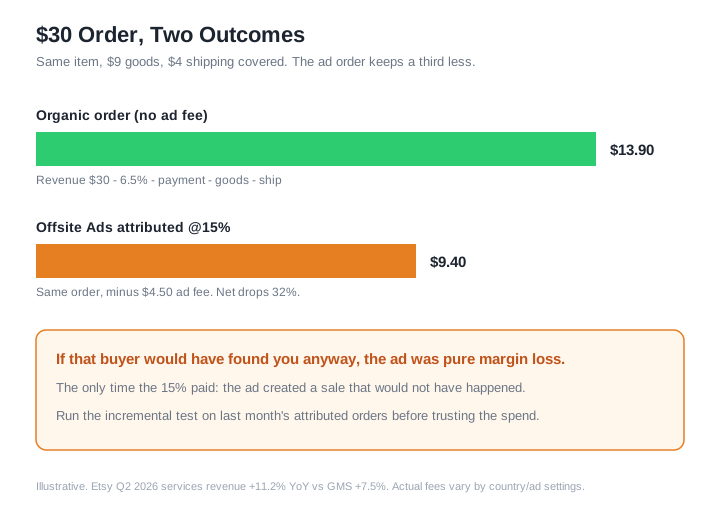
- Organic order: $30 − $1.95 (6.5%) − $1.15 (payment) − $9 (goods) − $4 (ship) = \\$13.90 kept\\.
- Same order attributed to Offsite Ads at 15%: $30 − $1.95 − $1.15 − $4.50 (15%) − $9 − $4 = $9.40 kept.
The ad cost you $4.50, about 15% of the order, and dropped your take by a third. If that buyer would have found you through Etsy search anyway, the ad was pure margin loss. The only time it paid was if the ad created a sale that would not have happened.
Where You Stand Depends on Your Shop
The "are my ads working" answer is different for each seller type.
New sellers under 15). Offsite Ads at 15% can erase margin entirely on attributed orders. Below $10K you can opt out in Shop Manager -> Settings -> Offsite Ads. If your items sell organically, opting out is often the highest-leverage move you can make. Do it before you rack up attributed orders you did not need. Etsy also gives new shops a search ranking boost on their first roughly 30 to 40 orders, so early sales are disproportionately organic anyway. The cleanest test: in your first few weeks, turn both ad types off for 14 days and watch whether orders still come through Etsy search. If volume holds, the ads were not buying you what the boost was already giving you for free. Turn them back on only if you can prove the ad-attributed orders are incremental, not just the organic boost wearing off.
\\Sellers at or above $10K trailing GMS.\\ Offsite Ads is mandatory at 12% for the life of the shop, even if sales later fall back below $10K. You cannot opt out. Your only lever is Etsy Ads budget control and ruthlessly pricing so the 12% still leaves a profit. Model the mandatory 12% into every listing price now.
Established shops already spending on Etsy Ads. Your question is not "should I run ads" but "which SKUs do ads actually grow." Pull your ad-attributed orders for the last 30 days, strip the ad fee, and see which products still net positive. Cut budget on the ones that do not. Etsy's budget pacing improved, but pacing is not the same as profitability.
How the Math Compares Across Platforms
Sellers ask whether Etsy ads are unusually expensive. The comparison is about control as much as rate.
| Platform | Ad model | Seller control | |
|---|---|---|---|
| Etsy (Etsy Ads) | Cost per click, daily budget | You set budget and max CPC; on by default | |
| Etsy (Offsite Ads) | 12 to 15% of attributed sale, $100 cap | Mandatory above $10K; no control | |
| eBay Promoted Listings | Percentage of sale, you set rate | You set rate and which listings | |
| Amazon PPC | Cost-per-click, you set bids | Full bid and keyword control | |
| Shopify (your own ad spend) | Whatever you spend on Meta/Google | You own the audience and data |
Etsy's Offsite Ads is the odd one: you pay a percentage of revenue with no ability to opt out once past $10K, and no visibility into which channel drove the sale. That is the part to watch most closely.
When Ads Are the Right Call
The point of this article is not "never advertise." It is "make the ad justify itself." A few situations where turning ads on passes the test:
- You have a proven converter with no organic ranking yet. A listing that sells well when seen, but sits on page 8, can use Etsy Ads to buy the visibility until organic rank catches up. The ad is bridge funding, not a permanent crutch.
- You are launching and need velocity. New listings with zero sales history get little organic push. A short Etsy Ads burst to land the first reviews and ranking signals often pays back through the organic sales that follow.
- Your average order value is high and Offsite's cap protects you. As covered above, the $100 cap means shops selling $800-plus items pay an effective rate well below 12%. If off-platform demand converts for you, Offsite can be a net win rather than a tax.
- You have measured incrementality, not guessed it. If a 14-day off-ads period dropped your orders by more than the ad spend you were paying, the ads were creating sales. That is the only signal that justifies keeping them on.
The distinction that matters: ads are a tool for discovery when you lack it, not a fee you owe on sales you were already going to get.
The Calculator: Test Your Ad Orders
The blended take rate hides whether your specific ad orders are profitable. Use the Etsy Fee Calculator to enter a real sale price with Etsy Ads on and Offsite Ads at 12 or 15%, and see what the ad order leaves versus the organic version. It models the transaction fee, payment processing, and the ad fee together so you can read the incremental cost instead of guessing.
If you are weighing Etsy's built-in traffic against running your own storefront, the Etsy vs Shopify Calculator compares all-in cost per sale on both, using your numbers.
Three Things You Can Do Today
1. Pull your last 30 days of ad-attributed orders. For Etsy Ads, open Shop Manager -> Marketing -> Etsy Ads and read the attributed orders there. For Offsite Ads, the attribution is not in the Marketing panel; it lives in Shop Manager -> Settings -> Offsite Ads (the dashboard and your Payment account line items show which orders were charged). List the attributed orders from both, then apply the incremental test above to three of them. If the ad fee pushed any below your organic net, that ad was not paying.
2. Cap or opt out the defaults. Etsy Ads: Shop Manager -> Marketing -> Etsy Ads, set a daily budget instead of leaving it uncapped. Offsite Ads: Shop Manager -> Settings -> Offsite Ads, opt out if you are below $10K (above it, the 12% is locked on). Do this before your next batch of listings goes live.
3. Reprice for the mandatory 12% if you are past $10K. Since you cannot escape Offsite Ads, bake the 12% into your floor price. A listing priced to the 6.5% world will not survive a 12% offsite attribute.
A quick gut check. Take one ad-attributed order from last week and run it through this:
Order revenue − 6.5% − (3% + $0.25) − ad fee − goods − shipping = what you kept.
If that number is lower than the same order without the ad fee, the ad bought you a sale you may have had anyway.
FAQ
Are Etsy ads worth it for new sellers? Sometimes, but not by default. If your items already sell organically, Offsite Ads at 15% (below $10K) often just taxes sales you would have gotten. Turn it off and watch whether volume drops. If it does not, the ads were costing you margin.
Can I opt out of Offsite Ads? Below $10K trailing sales, yes, in Shop Manager -> Settings -> Offsite Ads (the rate there is 15% if you keep it on). At or above $10K, participation is mandatory at 12% for the life of the shop, with no opt-out even if sales later fall below the threshold.
Why did Etsy's take rate go up if the transaction fee did not? The visible 6.5% transaction fee did not change. The increase came from services revenue, led by advertising. Management named ads the primary driver of take-rate expansion in both Q1 and Q2 2026.
How do I know which orders were ad-attributed? Etsy shows ad attribution in the Offsite Ads dashboard and as line items in your Payment account. Etsy Ads spend appears in the Etsy Ads summary. Neither gives a clean per-order net profit view, which is why the incremental test above matters.
Data sources: Etsy Q2 2026 Shareholder Letter (services revenue 2.6B, +7.5% YoY; revenue $668M) published August 5, 2026; Q2 2026 Earnings Call (take rate 25.9%, +130 bps YoY, ~80 bps from Reverb divestiture, remainder ad-structural; Adj. EBITDA margin 29.2%); services revenue growth via Nasdaq earnings coverage; Offsite Ads fee tiers and 30-day attribution per Etsy's Fees & Payments Policy and multiple seller-platform analyses (ecomcalctools, outfy, ehunt, craftybase, spyseller), cross-checked August 2026. Ad fee percentages and the incremental-profit example are illustrative; actual fees vary by country, ad settings, and average order value. Verify current rates in your Etsy Payments statement, as Etsy adjusts fees regularly.