Most new Etsy sellers plan their business around sales, not around when the money lands. A sale shows up in the dashboard, the order total looks healthy, and the assumption is that the cash is theirs to spend on the next batch of materials. It is not. Etsy separates "sold" from "available for deposit" through layers of holding periods and reserves, and a shop can post strong sales while its bank balance stays at zero. This article maps exactly where the money sits between a buyer's payment and your bank account, what triggers a reserve, and how to keep a growing shop from choking on its own cash flow.
Sold Is Not Spendable
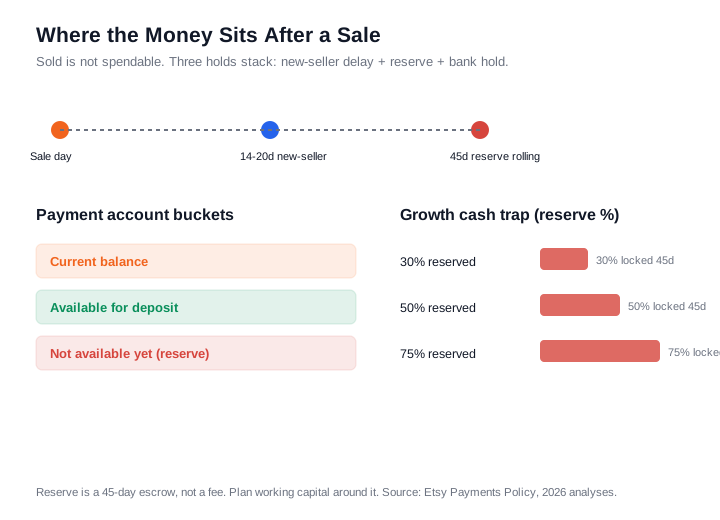
The first disconnect: when an order comes in, Etsy deducts fees and shows a net amount, but that amount is not "available for deposit" until it clears Etsy's availability rules. Your Payment account (Shop Manager -> Finances -> Payment account) separates three buckets: current balance, available for deposit, and not available yet. A sale can be real and completed while most of it sits in "not available yet" for weeks.
Three separate mechanisms can hold funds, and they stack:
1. New-seller availability delay. Etsy generally makes funds available 14 to 20 days after a sale for new sellers, sometimes longer depending on shop standing. This is a baseline timer, not a penalty.
2. Payment account reserve. A percentage of sales is held on a rolling basis for up to 45 days (steeper cases run 90 days), released as orders age past the window without refunds or disputes (Etsy's official explanation). Seller-platform analyses report observed ranges of roughly 30% to 75% for new or higher-risk shops, but Etsy does not publish a fixed rate and your actual percentage is set per shop; the first sale can be held 100% for up to 7 days while Etsy verifies the shop. Your real number is the one shown in Shop Manager -> Finances -> Payment account, not any industry average.
3. Bank security hold. Adding or updating bank details triggers a roughly 5-day security hold before deposits flow.
A shop can clear the 14-20 day timer and still show little to deposit because a 45-day rolling reserve is holding the bulk of it. Sellers blame "the delay" when they are actually inside a reserve they did not know existed.
What Triggers a Reserve (why Etsy holds your money and how to release it)
A reserve is Etsy holding a buffer against refunds, chargebacks, and disputes on orders that have not fully cleared risk-wise. The common triggers:
- A sudden order spike, especially in a high-demand or high-risk category. Growth itself can trigger a hold, which is the cruel part: your best month can be your tightest for cash.
- A jump in cases, chargebacks, or refunds. Each open case raises the risk score on the whole account.
- IP complaints or listing removals. Rights-holder strikes (trademark, copyright, counterfeit) make the account look riskier across the board, not just on the removed listing. Two verified IP strikes within a year is treated as a path to suspension, and a reserve is often the first financial symptom. Keep IP and compliance issues separate in your head: an IP complaint hurts account risk and can trigger a reserve or a suspension, but it is a distinct track from GPSR. GPSR non-compliance is a product-safety failure that gets individual EU listings removed or suspends EU sales; it does not itself place a payment reserve, though a wider account review after repeated removals can.
The mental model: a reserve is not money Etsy took. It is money held as insurance on orders that might still generate a refund. As each order passes the window cleanly, the buffer unwinds and the cash becomes available.
How to Release Reserved Funds Faster
You have more control over a reserve than sellers assume. The single strongest lever is tracking.
- Upload valid tracking for every physical order. When Etsy can confirm from carrier scans that an order is in transit or delivered, the main risk it guards against (an "item never arrived" claim) drops, and the reserved portion can release well before the full 45 days. Buying Etsy shipping labels triggers this automatically.
- Hit Star Seller metrics. Strong shipping and response performance lower the likelihood of being placed on reserve in the first place.
- Respond to cases within 24 hours. Swift dispute resolution prevents the "high risk" flagging that leads to account-wide holds.
- Verify your bank with instant Plaid rather than micro-deposits to save the setup days, and avoid changing bank details mid-growth-spurt.
The practical rule: if you sell physical goods under a reserve, upload tracking on every order without exception. It is the cleanest way to shrink the held balance.
Why Does Etsy Hold My Money Even After the Item Ships?
Because the hold is not about fulfillment, it is about risk. The new-seller 14 to 20 day availability delay and the rolling reserve both exist so Etsy can cover refunds, chargebacks, and disputes that surface after delivery, not to confirm the parcel moved. A shipped and delivered order can still sit in reserve for the full 45-day window, and the first sale can be held up to 7 days while Etsy verifies the shop. Tracking uploaded on time does not end the hold; it only helps release the reserve on schedule. Plan cash flow on what you can actually withdraw, not on what you shipped.
The Cash-Flow Trap During Growth
This is where reserves hurt most. A handmade seller during a holiday rush can watch sales climb while available-for-deposit stays a fraction of total, because 30 to 75% of each sale is reserved on a rolling cycle. You owe suppliers and material costs now, but the money funding those orders is locked for up to 45 days. A shop can be "successful" on paper and unable to buy the inventory to fulfill the next wave.
The fix is planning, not panic: model your reserve percentage into your working-capital math before you scale. If you expect 50% of revenue to be unavailable for 45 days, you need enough cash outside Etsy to fund the next cycle. Shops that scale ad spend and inventory off "sales" rather than "available deposits" are the ones that stall.
A minimal model: available cash next cycle ≈ monthly sales × (1 − reserve%) × turnover factor, where the turnover factor accounts for how much of the unreserved portion has actually cleared the new-seller delay and any bank hold by the time you need it. Run it with your own reserve percentage from Payment account, not an assumed one. The point is to stop treating "sales" as spendable cash; only the deposited slice is.
The Calculator: Model the Held Cash
Before a growth push, see what a reserve does to your liquidity. The Etsy Profit Margin Calculator shows per-order margin after fees and cost of goods, which is the number you can actually reinvest. The Etsy Fee Calculator breaks down the fee stack so you can separate what Etsy kept from what Etsy is merely holding. Neither tells you the reserve release date, but together they show how much of your "sales" is real working capital versus money in a 45-day escrow.
Three Things You Can Do Today
1. Open your Payment account and find the Reserve section. Shop Manager -> Finances -> Payment account. Read the reserve percentage, the holding period, and the estimated availability timing. If you did not know you had one, that explains the zero balance.
2. Turn on tracking for every order. If you are under a reserve, this is the fastest release lever. Buy Etsy labels or upload carrier tracking the moment an order ships.
3. Model 45-day reserves into your scaling plan. If you are about to push ads or restock, assume a large share of revenue is locked for up to 45 days. Keep enough outside cash to fund the next cycle, or the growth chokes itself.
4. Set your deposit schedule on purpose. In Shop Manager -> Finances -> Payment account you can choose daily, weekly, or monthly deposits. Daily moves money out fastest once it clears, but a reserve still gates the bulk; pick the cadence that matches your bill calendar rather than leaving it at default.
A quick gut check. Take this month's sales total and multiply by your reserve percentage. That is the cash you will not touch for up to 45 days. If covering next month's materials depends on it, your shop is one growth spike from a cash crunch.
FAQ
When do new sellers actually get paid? Etsy generally makes funds available 14 to 20 days after a sale for new sellers, sometimes longer by shop standing. That is before any reserve; a reserve then holds a percentage for a further rolling window.
What does "not yet available" mean? It means Etsy is holding those funds in your Payment account, not counting them as available for deposit. The most common causes are the new-seller delay, a payment reserve, a bank security hold, or fees and refunds eating the balance.
How long is a payment reserve? Reserved funds typically release 45 days after each sale's date on a rolling basis; steeper risk cases run 90 days. Uploading valid tracking can release the reserved portion earlier.
Can I avoid a reserve? You cannot opt out, but lower-risk shops are less likely to get one. Star Seller metrics, fast case responses, valid tracking, and avoiding IP complaints reduce the chance and the percentage.
Why did a reserve start during my best sales month? A sudden order spike, especially in a high-risk category, is itself a common reserve trigger. Strong growth can tighten cash exactly when you need it, so plan working capital around the hold.
Reserve and availability rules per Etsy's Payments Policy and Payment Account help documentation (help.etsy.com), cross-checked August 2026 with seller-platform analyses (optilist, shieldmyshop, spyseller). Confirmed: new-seller funds generally available 14-20 days after sale; Payment account reserve holds a percentage on a rolling up to 45 days (steeper cases 90 days); first sale may be held up to 7 days; bank-detail changes trigger ~5-day security hold; valid tracking can accelerate release; reserve triggers include order spikes, cases, chargebacks, IP complaints. Etsy states it does not publish the specific logic or thresholds used for reserves. Third-party sources cite 30-75% reserve ranges for new or high-risk shops, which are observed patterns, not Etsy-published fixed rates. Verify your specific reserve terms in Shop Manager -> Finances -> Payment account, as Etsy sets them per shop.