Most Etsy sellers treat unsold inventory as a problem they will fix later. The inventory sits in a closet, a garage, or a storage unit, and the cost feels like it is already paid. It is not. Dead stock keeps charging you every month it stays unsold, through the cash it ties up, the space it occupies, and the sales it blocks. This article builds a simple model to put a monthly number on that hidden cost, and shows when cutting the price to clear it is the cheaper move.
The Cost You Do Not See on the Shelf
When a handmade or wholesale item does not sell, the loss is not only the money spent making or buying it. Three costs keep accruing while it sits:
1. Capital cost. The cash locked in that inventory could be earning a return elsewhere, or it is sitting on a credit-card balance accruing interest. Either way, tied-up cash has a monthly price.
2. Storage cost. A closet is free until it is full. A storage unit is not. Even at home, every bin of dead stock is space you cannot use for inventory that does sell.
3. Opportunity cost. The time, shelf space, and renewal fees spent holding dead stock are time and space not spent on the products that move.
None of these shows up as a line item. That is why dead stock feels harmless and stays forever.
A Simple Monthly Cost Model
Here is the model. For any batch of unsold inventory, the monthly carrying cost is:
Monthly carrying cost = (capital tied up × monthly capital rate) + (storage cost allocated to this batch) + (renewal or platform fees allocated to this batch)
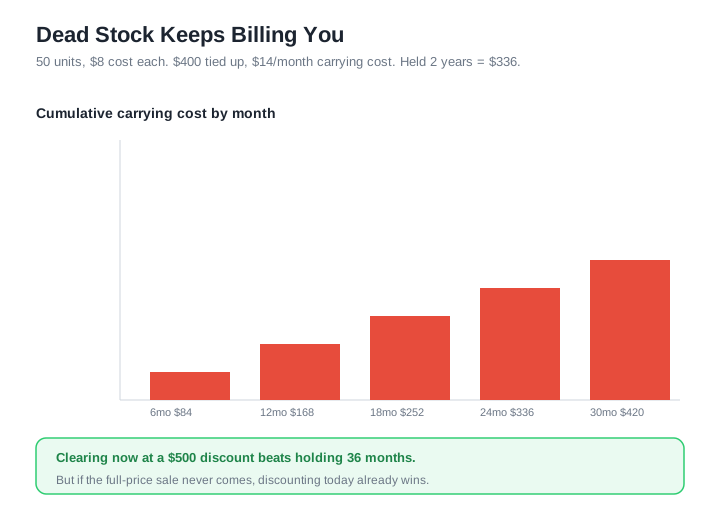
Worked example. You made 50 units of an item at $8 each, so $400 is tied up. Your capital rate is what that cash would otherwise cost or earn. If the cash is on a credit card or a loan, use that interest rate (12% APR is 1% per month). If the cash is debt-free, the honest rate is your next-best alternative return, not zero: a money-market fund or short-term Treasury earns roughly 0.3 to 0.4% per month in recent conditions, and that is the floor for what idle cash costs you in forgone yield. Calling it 1% per month is conservative for a debt-free seller; 0.3% is more realistic. Storage allocates $10 per month to this batch. Etsy listing renewal is negligible for a multi-quantity listing, so assume $0 here.
- Capital cost: $400 × 1% = $4.00 per month (conservative; use 0.3% if debt-free, per above)
- Storage: $10.00 per month
- Renewal: $0 (multi-quantity listing, one listing covers all 50 units)
- Total: $14.00 per month to hold 50 dead units
One renewal caveat: Etsy charges $0.20 each time a listing is created, and auto-renews roughly every 4 months (about 3 times a year) until it sells out (per \Etsy's Fees & Payments Policy\). If you listed those 50 units as 50 separate single-quantity listings rather than one multi-quantity listing, the renewal cost is $0.20 × 50 units × 3 renewals = $30 per year, not $0. That is another reason multi-quantity listings beat listing the same stock in pieces: dead stock in separate listings keeps paying renewal fees forever.
That is $168 per year, on inventory you already cannot sell at full price. Held for two years, the carrying cost alone is $336, against goods you paid $400 for. The "later" you keep waiting for never comes cheaper.
The Decision Rule: Hold or Clear
The question is not "should I discount." It is "what is the break-even holding period before discounting beats waiting." Compare the carrying cost of waiting against the loss from discounting now.
Discount loss = (original price − clearance price) × units
Months before holding costs exceed discount loss = Discount loss ÷ Monthly carrying cost
Same example. Original price $28, clearance price $18, 50 units.
- Discount loss if cleared now: ($28 − $18) × 50 = $500
- Monthly carrying cost: $14
- Break-even: $500 ÷ $14 ≈ 36 months
On this math, holding wins for three years, but only under one specific assumption: that the item will eventually sell at $28. If you can name a real event that brings that full-price buyer (a season, a confirmed wholesale order), holding to month 36 is break-even versus clearing now. If you cannot, the assumption is doing the work. The harder case is demand that is gone, not delayed: if the item will never sell at any price near $28, then the $28 column is fiction, and the realistic choice is between clearing now at $18 or holding forever and collecting nothing while paying $14 a month. Note the clearance number too: selling 50 units at $18 grosses $900, but after Etsy's 6.5% transaction fee and $0.25 per-order payment fee you actually collect about $830, not $900. The break-even formula above uses the gross price gap ($10 per unit) as the discount loss, which is the right way to frame the \opportunity\ cost of clearing; just do not mistake $900 for cash in hand when you run the clearance. In the demand-gone case, clearing now wins on every month after the first. The model only favors holding if you have a real reason the full-price sale is coming, and a date attached to it.
The practical rule: if you cannot name a specific event that brings the full-price buyer (a season, a trend rebound, a wholesale order), discount now. The carrying cost is certain; the future full-price sale is a hope.
Where Dead Stock Comes From on Etsy
A few patterns show up repeatedly:
- Over-production of a trend item. You made 100 of what sold 20 of, betting the trend holds. It did not.
- Supplier minimums. You bought 200 to hit a price break and moved 60.
- Listing experiments that flopped. You tested a design, it did not convert, and the stock sits.
- Seasonal miss. Holiday inventory that did not clear before December 26.
Each is normal. The mistake is treating the leftover as frozen rather than as a monthly expense.
Stopping Dead Stock Before It Exists
Clearing is damage control. The cheaper fix is not creating the dead stock. Four habits that cut the inflow:
- Make to order for unproven designs. Until a design has sold steadily, do not pre-build 100 of it. List it made-to-order or in a tiny batch, and let demand tell you the run size. The trend-item over-production above is mostly avoidable this way.
- Hit supplier minimums only with confirmed velocity. A 200-unit price break is not a deal if 140 units sit. Either pre-sell enough to justify the minimum, or skip the break and buy what you can move.
- Cap each batch with a holding deadline at purchase. When you buy or make a batch, write the clearance date on it the day it arrives. A batch with a preset exit date does not quietly become permanent.
- Track sell-through, not just sales. A design that sold 20 of 100 is not "selling," it is 80% on its way to dead. Watch the ratio, and trigger clearance the moment it drops below your threshold, before the carrying cost compounds.
The carrying-cost model earlier tells you what dead stock costs once it exists. These habits keep the bin from filling in the first place.
Why Clearing Is Often the Profit Move
Sellers resist discounting because it feels like realizing a loss. But a discount is a smaller, known loss today versus a larger, certain carrying cost plus an uncertain sale later. Two more factors push toward clearing:
1. Cash velocity. $400 freed from dead stock, reinvested in a product that turns over monthly, can earn back the discount many times over in a year.
2. Storage creep. Dead stock accumulates. The $10 monthly storage allocation grows as bins multiply, and at some point a paid storage unit enters the picture, turning carrying cost into a real bill.
A quick way to frame it for yourself: every month a dead unit sits, you are choosing to pay its carrying cost instead of banking the cash. That is a recurring decision, not a one-time mistake.
The Calculator: Size Your Dead Stock
The model above is easy to run by hand, but if you want to test scenarios across several batches, the Etsy Profit Margin Calculator lets you set cost, price, and volume and see margin per unit. Pair it with the carrying-cost formula here: take the total cost tied up, apply your monthly capital rate, add allocated storage, and you have the number to compare against any clearance discount.
If you are deciding whether to keep producing a slow mover, the Etsy Fee Calculator shows what a discounted sale actually nets after Etsy's fees, so you can see the real floor.
Three Things You Can Do Today
1. List your dead stock with a number. For each batch, write down units, cost per unit, and the cash tied up. Multiply by your monthly capital rate. That single column is usually the wake-up.
2. Put a holding deadline on everything. For each batch, set a date (60 or 90 days out) after which it goes to clearance price, no exceptions. The deadline forces the decision the model recommends.
3. Free the cash, do not store the hope. When the deadline hits, discount to clear, even if it stings. Reinvest the freed cash in inventory that turns. The carrying cost you stop paying is a real return.
A quick gut check. Take one bin of unsold stock:
Cost tied up × 1% (monthly) + storage allocated = what that bin costs you every month it sits.
If that number surprises you, the stock is already more expensive than you thought, and it gets more expensive every month.
FAQ
Is dead stock really a monthly cost if it is in my closet? Yes, in two ways. The cash tied up has a capital cost (interest if borrowed, or forgone return if not), and the space it occupies is space not used for selling inventory. Even free storage has an opportunity cost.
When is holding actually the right call? Only when you can name a specific, near-term event that brings the full-price buyer: a known season, a confirmed wholesale order, a trend rebound with evidence. If the full-price sale is a hope rather than a plan, the model favors clearing.
Should I discount all dead stock at once? Not necessarily. Rank batches by carrying cost per month and clear the most expensive first. A $400 tie-up at 1% monthly costs more than a $40 tie-up, so it gets priority.
Does Etsy charge fees on clearance listings? Yes, the standard 6.5% transaction fee and payment processing apply to the discounted sale price, the same as any sale. The Etsy Fee Calculator shows the net after fees so you can confirm the clearance price still clears your cost.
The carrying-cost model, break-even formula, and worked examples are illustrative and based on standard inventory-accounting principles (capital cost of tied-up cash, allocated storage, opportunity cost). Specific rates (1% monthly capital, 0.20 listing fee) per Etsy's Fees & Payments Policy, verified August 2026. No external market data is cited because dead-stock carrying cost is a seller-internal calculation, not a published Etsy metric.