If you sell on Amazon, open one of your listings on a different account or ship-to address and look just under the Buy Box. On some product pages, the row of alternative sellers — the "Other Sellers on Amazon" box — is simply gone. Not moved, not collapsed neatly, just missing. Sellers across forums have been comparing screenshots for weeks, and the same ASIN shows the box to one shopper and hides it from another. Amazon has not announced anything. Everything points to a live A/B test. But the direction is hard to miss: Amazon is pulling secondary seller exposure away from the product page and pushing it toward the Buy Box.
This matters because that little box was never little for everyone. For sellers who piggyback on an existing listing or fulfill from their own warehouse (FBM), it was one of the last free, no-ad-spend doors to a sale. If it closes, a whole class of "I'll just undercut and ride the traffic" sellers loses its easiest lane.
What the "Other Sellers on Amazon" Box Actually Does
The box sits beneath the Offer Display (the part most sellers still call the Buy Box). According to Amazon's own help page, it displays listings from up to three eligible sellers who have consistently given customers a good experience, chosen by price, availability, and the shopper's delivery address. It also carries a link to the "All Offers" page, where every matching offer lives.
![Annotated Amazon product detail page: the main Buy Box at top, with the secondary Other Sellers on Amazon box below showing up to three alternative sellers.]
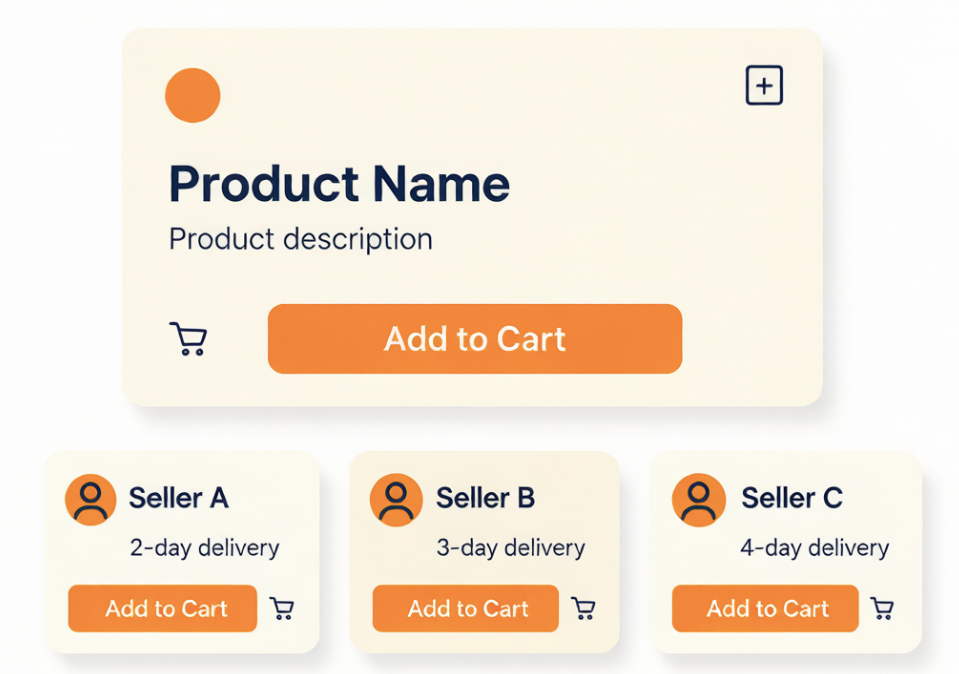
The companion offer placement guide explains the rest of the mechanics: beyond the main Featured Offer, up to three additional eligible offers show in that box, and anything left over sits behind the "new & used" link on a separate offer listing page. In plain terms, the box was a structured second chance — a place where a cheaper or faster-shipping rival could still catch a buyer who didn't immediately click "Add to Cart."
For piggyback sellers, that second chance was the business model. Build no listing, spend no ad budget, just attach a lower price to someone else's detail page and let the comparison do the work.
What Sellers Are Actually Seeing in the Test
The reported changes line up across multiple seller reports:
- On some ASINs, the "Other Sellers on Amazon" box disappears entirely from the detail page.
- The same ASIN renders differently depending on the account and ship-to ZIP, which is the signature of an A/B test rather than a full rollout.
- When the box is hidden, the only way to see other sellers is a folded "All offers" or "More Buying Choices" entry that sends the shopper to a secondary page.
- At the same time, Amazon is testing surfacing "More Buying Choices" directly on the search results page, so a buyer can compare sellers without ever opening the listing.
Here's the telltale sign sellers keep posting side by side: open the same ASIN in two browser profiles — or just switch the ship-to ZIP — and the box shows up in one view and vanishes in the other. That inconsistency isn't a glitch. It's the fingerprint of a live experiment, and it tells you Amazon is measuring exactly how many shoppers still go hunting for the cheaper offer once the box is pushed one click further away.
None of this is official yet. Amazon hasn't published a policy change, and the Featured Offer help content still describes the "Other sellers on Amazon" widget as a normal part of the Offer Display. The core rule hasn't changed either: multiple sellers can still offer the same product on one ASIN. What's shifting is visibility, not the right to sell.
That distinction is the whole story. Amazon isn't banning piggybacking. It's making piggybacking far less visible.
Why Amazon Is Doing This — and the Bigger Buy Box Shift
Step back and the move fits a pattern Amazon has stated openly. In its explainer on how offers are selected, Amazon says the Featured Offer is the one its data predicts a customer is most likely to buy, and that all offers — Amazon's own retail and third-party sellers — compete on the same criteria: low total price, fast delivery, good service, reliable promises. It also notes Amazon's own retail has offers on less than 5% of products that carry a featured offer, so this is overwhelmingly a third-party marketplace.
Amazon's pitch is plain: put the one offer it's most confident a shopper will buy front and center, and leave the rest a click behind. This test just pushes that "rest" one shelf deeper.
There's a second, bigger shift running underneath it. In July 2026, Amazon's official Seller Forums account announced it would remove the standalone seller-performance eligibility gate for the Featured Offer — first for EU and UK sellers on July 20, 2026, then phased globally through the end of 2026. Sellers no longer need to clear a performance threshold just to enter the Buy Box competition; offers are ranked together on price, delivery speed, and performance. Amazon stresses the selection method itself isn't changing.
Read both moves as one and a pattern appears: the Buy Box is turning into the only arena that matters. With more sellers fighting for it, your price and speed get compared earlier — often before a shopper even lands on your page.
There's a commercial reason behind the cleaner storefront, too. As low-price rivals like Temu and TikTok Shop pulled shoppers away, Amazon has been nudging its main marketplace upmarket — toward curated, branded, faster-delivery experiences — and quietly draining the bare-bones price comparison that fueled the race to the bottom. One analysis ties the push to dilute follow-selling directly to that pressure: with Temu and TikTok Shop sweeping the market on "low price + no-brand," Amazon is steering its flagship store toward "curated products + brand operation" and moving comparison off the detail page and onto the search results, where it competes on Amazon's own terms (Amazon Implements Strict Measures: The Tide of Listing Piggybacking Is Receding).
![Funnel diagram: many alternative sellers narrow into a single Buy Box, showing traffic and competition concentrating on the Featured Offer.]
Who Wins and Who Loses
Loses first: piggyback sellers and FBM sellers. The "Other Sellers" box was their free discovery channel. Weaken it and their organic reach shrinks, especially on commodity products where the only differentiator was a lower price.
Also exposed: brand owners with multiple authorized resellers. When price comparison moves up to the search page, inconsistent pricing across sellers becomes visible immediately, and a cheaper authorized seller can undercut the brand's own offer in plain sight.
Wins: sellers who built their own listings, enrolled in Brand Registry, and earned the Buy Box on merit. If the secondary box fades, traffic concentrates on the Featured Offer — which means the seller already controlling that offer keeps more of the sale. The catch is that winning the box now means winning on price and speed against a bigger field.
A Seller's Adaptation Playbook
You don't get a vote on whether this test ships. You only get a vote on whether you're ready when it does.
![Five-step seller adaptation playbook: win the Buy Box, diversify traffic, build a moat, monitor metrics, keep pricing consistent.]

1. Make the Buy Box your default, not your hope. Amazon's Featured Offer guidance is blunt about what wins: price competitively including shipping, offer fast and free delivery, keep a clean order experience, and never go out of stock. With the performance gate gone, these operational basics are now the entire differentiator for more sellers.
2. Stop relying on one entry point. If the "Other Sellers" box was doing quiet work for you, replace it on purpose. Sponsored Products and Sponsored Brands, a Brand Store, Posts, and steady external traffic all build paths that don't depend on a comparison widget. Losing the box should never mean losing your only route to the customer.
3. Build a moat that piggybackers can't copy. Enroll in Amazon Brand Registry, a free program that unlocks A+ Content (well-implemented Premium A+ can lift sales by up to 20%), Transparency serialization (more than 2.7 billion units verified genuine), and tools like Report a Violation and Project Zero to remove counterfeits fast. Exclusive or private-mold ASINs and real product differentiation are what actually reduce how much a low-price copy can hurt you.
4. Watch the numbers, not the rumors. Track your Buy Box share, conversion rate, and order volume week over week. A real layout change shows up in those metrics before it shows up in a forum post. Decide based on your data, not someone else's screenshot.
5. Keep your price story consistent. With comparison moving to the search page, gaps between your price and a reseller's price — or between your Amazon price and your own site — become obvious fast. Align them or accept the leakage.
The Bottom Line
Amazon isn't ending multiple-seller listings. It's reorganizing where shoppers see them. The free, passive exposure that piggyback and FBM sellers relied on is being pushed down a level, while the Buy Box absorbs more of the traffic and the competition gets more transparent. Sellers who win from here are the ones who already treat the Buy Box, their brand, and their service as the product — not the ones hoping a comparison box keeps handing them strangers' traffic.
Frequently Asked Questions
Is Amazon removing the "Other Sellers on Amazon" box for everyone?
Not yet. Current reports describe an A/B test where the box appears for some shoppers and disappears for others on the same ASIN. Amazon hasn't made a formal announcement, and the underlying rule allowing multiple sellers on one ASIN is unchanged.
Can I still sell the same product as other sellers (piggyback)?
Yes. The test changes how other sellers are displayed, not the right to offer the same product. You can still list on an existing ASIN; you just may get less free visibility from the detail-page box.
What is the Featured Offer, and how do I win it?
The Featured Offer (still widely called the Buy Box) is the prominent Add to Cart area at the top of a listing. Amazon selects it on price including shipping, delivery speed, and service quality. Keeping inventory in stock and pricing competitively are the baseline requirements.
Did Amazon change Buy Box eligibility in 2026?
Yes. In July 2026 Amazon confirmed it would remove the separate seller-performance eligibility gate for the Featured Offer — starting with EU and UK sellers on July 20, 2026, and rolling out globally through the end of 2026. How the offer is selected does not change.
How does Brand Registry help against piggybackers and counterfeiters?
Brand Registry is a free program that gives you A+ Content, Transparency product codes, and self-service tools like Report a Violation and Project Zero to find and remove infringing or counterfeit listings. It strengthens your control over a listing you own.